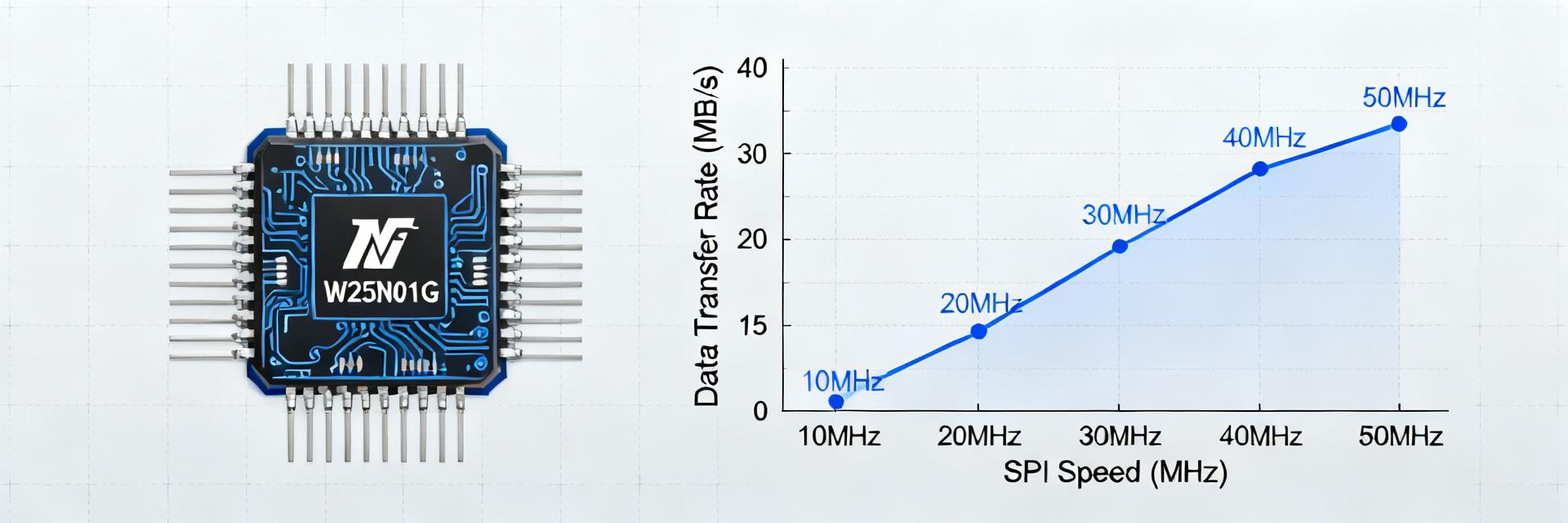
In lab benchmarks, modern 1Gb SPI NAND parts reach clock domains near 133 MHz and Quad I/O sequential reads that scale into the tens of MB/s, illustrating why part selection matters for boot and logging tasks. This brief report focuses on GD5F1GM7UEYIGR, presenting a compact performance-and-specs summary and pragmatic guidance engineers can use when evaluating this 1Gb SPI NAND for embedded designs.
The document emphasizes measurable metrics—throughput, latency, endurance, and test methodology—so teams can run repeatable evaluations and map observed numbers to system-level behaviors such as boot time and sustained logging throughput.
1 — Quick overview: GD5F1GM7UEYIGR & SPI NAND fundamentals

1.1 — What this part is (density, package, interface)
Point: The device is a 1 Gbit (128M x 8) SPI NAND in common small-outline packages that supports standard single, dual, and quad SPI modes and often offers Double Transfer Rate (DTR) variants.
Evidence: typical supply ranges are in the 2.7–3.6 V window.
Explanation: at a glance on a datasheet an engineer should confirm density, organization (page/block sizes), supported I/O widths (x1/x2/x4), max clock, VCC range, and on-chip ECC presence.
1.2 — Core SPI NAND concepts that affect performance
Point: Page size (e.g., 2048+OOB) and block size determine erase granularity and the cost of random writes.
Evidence: on-chip ECC and I/O width (x1/x2/x4) change usable throughput and latency.
Explanation: wider I/O and higher clock produce higher sequential throughput, while page/program latencies and internal GC alter random performance; use the “SPI NAND 1Gb overview” checklist when comparing parts.
2 — Raw performance specs: throughput, clock, and I/O modes
2.1 — Sequential read/write throughput and clock limits
Point: Maximum practical throughput is a product of clock frequency and effective bits-per-cycle; a 133 MHz clock with Quad I/O yields tens of MB/s. Evidence: single-bit transfer at 133 MHz yields ~16.6 MB/s, quad at same clock approaches ~66.5 MB/s; DTR modes can double that under ideal conditions. Explanation: designers should translate clock limits into MB/s for the specific controller overhead and command framing used in their platform.
| I/O mode | Bits/clock | Clock (MHz) | Theoretical Mbps | Theoretical MB/s |
|---|---|---|---|---|
| Single (x1) | 1 | 133 | 133 | 16.6 |
| Dual (x2) | 2 | 133 | 266 | 33.3 |
| Quad (x4) | 4 | 133 | 532 | 66.5 |
| Quad DTR (x4, DTR) | 8 effective* | 133 | 1064 | 133.0 |
*DTR doubles effective transfers per clock by using both edges; command overhead and controller limitations typically reduce achievable numbers.
2.2 — DTR and Quad I/O behavior for peak performance
Point: Quad I/O reduces command-phase-bound bandwidth limits, and DTR increases per-clock throughput. Evidence: switching from single to quad often multiplies sequential read bandwidth by ~3–4× in practice; enabling DTR can further double peak rates. Explanation: be aware of command overhead (address cycles, dummy cycles) and controller bus contention; profile end-to-end throughput rather than relying solely on theoretical numbers.
3 — Latency, random I/O, and IOPS characteristics
3.1 — Random Read/Write Latencies
Point: Random small-block operations are dominated by page-read and program latencies. Evidence: page reads take hundreds of microseconds, mapping to tens to hundreds of IOPS. Explanation: measure read latency per page; sequential MB/s is not predictive of random IOPS.
3.2 — Impact of ECC Operations
Point: On-chip ECC adds latency variance. Evidence: ECC correction and internal GC introduce tail latency and transient drops. Explanation: monitor 50th and 95th percentile latencies to reveal GC-induced stalls.
4 — Reliability & endurance: retention, P/E cycles, and operating conditions
4.1 — Program/erase cycles: Endurance depends on intrinsic P/E cycle ratings and the ECC margin available to correct bit errors as the device wears. Evidence: 1Gb SPI NAND parts commonly specify endurance in the tens of thousands of cycles. Explanation: rate endurance for your application by modeling update frequency and wear-leveling.
4.2 — Temperature & Power: Industrial temperature ranges and power modes influence reliability. Evidence: typical ranges span -40°C to +85°C. Explanation: validate read/program reliability at temperature extremes and include decoupling considerations in hardware design.
5 — Benchmark methodology
5.1 — Recommended test setup
Checklist items include SPI clock setting, I/O mode selection, host buffer alignment to page size, decoupling, stable power rail, and known flash state. Log throughput, median/95th percentile latency, and error counts.
mode=quad;
read_cmd=0xEB addr offset len;
time the operation and compute MB/s;
6 — Design recommendations & selection checklist
- ✓ Application Fit: Well suited for boot storage and cost-sensitive logging where moderate throughput and compact density are primary.
- ✓ Firmware Optimization: Enable Quad I/O, align transfers to device page size, and tune SPI controller FIFO/DMA settings.
Summary (Conclusion & Quick Spec Callout)
- The GD5F1GM7UEYIGR delivers a practical balance of density and sequential throughput: with Quad I/O at ~133 MHz you can expect tens of MB/s sustained reads.
- Random I/O and perceived latency are governed by page/program timing and internal GC; measure 95th percentile latencies for boot behavior.
- For cost-sensitive applications, configure Quad I/O and align to page boundaries to validate endurance before deployment.
Frequently Asked Questions
How should engineers interpret SPI NAND performance numbers?
Focus on end-to-end metrics: median latency, 95th percentile, and sustained MB/s under representative workloads. Theoretical throughput must be contextualized with command overhead and controller limitations.
What benchmark steps reveal real-world boot performance?
Run cold-boot sequential reads across the firmware image using Quad I/O at the intended clock, measure total image read time, and report effective MB/s across temperature extremes.
Which firmware practices most improve SPI NAND performance?
Enable wider I/O modes, align transfers to page sizes, use DMA or large FIFO bursts to reduce per-transaction overhead, and implement wear-leveling to avoid endurance hotspots.